
Pruning
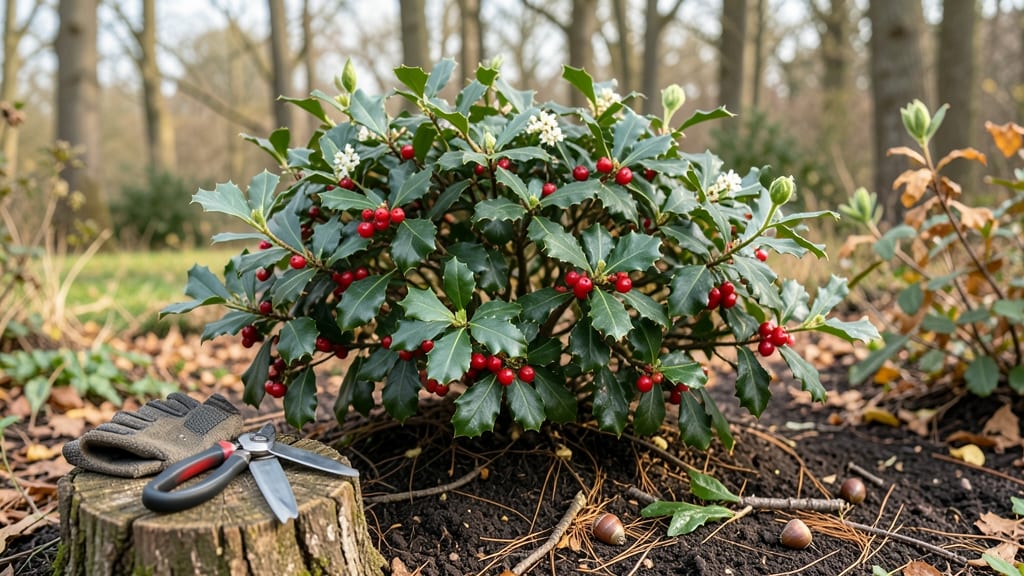
When to prune holly is right after flowering in late winter or early spring before new growth starts, avoiding late fall or winter when flower buds form for next year. Never prune in summer or fall to protect blooms and future growth.
Timing matters because holly plants rely on dormant buds that form in late summer and fall for next year's flowers. 🌿 If you prune too late, you risk cutting off these buds before they bloom, leaving your plant bare.
I've seen many gardeners accidentally strip their holly of flowers by pruning in late winter or early spring—just when the buds are most vulnerable.
The best approach is to wait until after the flowers fade completely, then trim back any dead or overgrown branches while the plant is still dormant but safe.
For American holly and English holly, the exact timing can vary slightly, but the core principle remains the same. 🌟 American holly often blooms earlier in late winter, while English holly may flower a bit later in early spring.
Always check your specific variety's flowering pattern to avoid disrupting its natural cycle. The key is to prune after the blooms drop but before the new growth begins—this window ensures you don't accidentally remove next year's flowers.
💡 In This Article
- Holly Flowering Cycle and Pruning Science
- Step-by-Step Holly Pruning Guide by Season
Holly flowering cycle and pruning science
Holly plants follow a precise biological cycle where flower buds form in late summer and early fall, remaining dormant through winter until they bloom in late winter or early spring. These buds develop on old wood—meaning they grow from branches that are at least one year old.
When you prune too late in winter, you risk cutting off these critical buds before they have a chance to open into flowers. 🌸 The timing is especially delicate because holly flowers are perfect, meaning each bloom contains both male and female parts, and they rely on pollinators like bees to spread pollen within the same plant.
The flowering window for most holly varieties—like the popular Ilex opaca (American holly) or Ilex aquifolium (English holly)—typically spans 4-6 weeks in late winter to early spring.
For example, American holly often blooms between February and March in warmer climates, while English holly may flower slightly later, around March to April. Pruning too early can remove these buds entirely, while waiting too long risks encouraging new growth that could be damaged by late frosts.
The ideal pruning window opens 2-4 weeks after the last flower has faded, ensuring buds are safely formed but not yet vulnerable.
What most gardeners overlook is how holly’s growth pattern differs from other shrubs. Unlike fast-growing plants that can recover quickly from pruning, holly grows slowly and relies on its established structure. Cutting back too aggressively—especially in late winter—can stress the plant and reduce next year’s flower production by 30-50%.
This is why I always recommend a light touch during pruning, focusing only on removing dead, diseased, or crossing branches rather than heavy shaping. The goal is to maintain the plant’s natural form while preserving its flowering potential.
Species-specific variations also play a role. American holly, for instance, produces bright red berries that mature in 8-9 months after flowering, while English holly has black berries and a slightly later fruiting cycle.
These differences mean their pruning windows can shift by 1-2 weeks, so always observe your specific holly’s flowering pattern before pruning. For example, if your holly blooms in late February, wait until mid-to-late March to prune—this ensures the buds are fully set for next year’s display.
Another critical factor is temperature. Holly buds are most vulnerable when temperatures hover around 40-50°F during late winter, a common range in many climates. Pruning during this period can trigger premature bud break, leaving the plant exposed to frost damage.
To avoid this, I always check the 10-day forecast before pruning—if frost is predicted, it’s safer to wait another week. This patience ensures the plant can recover without stress, maintaining its health and flowering capacity for years to come.
For those with dwarf holly varieties, like Ilex 'Blue Princess' or 'Dwarf Burford', the principles are the same, but the scale is smaller. These varieties still form buds on old wood, so the same late-winter pruning risks apply.
However, their compact size means you can be slightly more precise with cuts, as even a 1-inch mistake can be more noticeable. Always use sharp, clean pruners to make 45-degree cuts just above a bud or branch collar to promote faster healing and reduce disease risk.