
Pruning
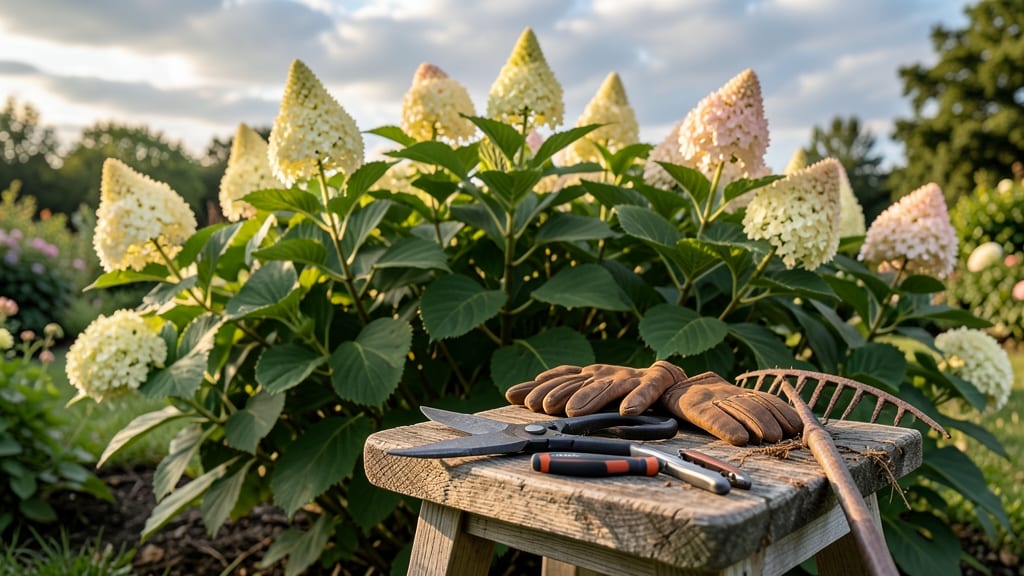
To prune Peegee hydrangeas, focus on late summer or early fall timing—right after the blooms fade—to promote next year’s flowers, while avoiding winter cuts that risk removing dormant buds. Always use sharp shears to trim stems just above a leaf node, keeping cuts to no more than one-third of the plant’s height.
Peegee hydrangeas bloom on old wood, meaning their flower buds form the previous season. 🌿 Cutting them back in winter or spring removes those buds entirely, leaving you with no flowers.
The key is to wait until after blooming—typically August through September—to prune, which gives the plant time to set new buds for next year. I’ve seen gardeners accidentally over-prune by more than one-third, which stresses the plant and weakens its growth. Always step back after trimming to check proportions!
For best results, use clean, sharp pruners to make clean cuts just above a leaf node or outward-facing bud. This encourages bushier growth and more abundant blooms. Deadheading spent flowers throughout the season also helps maintain a tidy appearance while directing energy toward new growth.
💡 In This Article
- Best Pruning Timing for Peegee Hydrangeas
- Step-by-Step Peegee Hydrangea Pruning Guide
Best pruning timing for Peegee hydrangeas
Peegee hydrangeas (Hydrangea paniculata 'Grandiflora') bloom on old wood, meaning their flower buds form in late summer or early fall of the previous year. Unlike mophead or oakleaf varieties that bloom on new wood, pruning Peegee hydrangeas at the wrong time removes these dormant buds entirely.
The plant’s natural cycle relies on warm summer temperatures (around 75-85°F) to trigger bud formation, which is why late summer or early fall pruning—after blooms fade—is critical. This timing allows the plant to set new buds before winter dormancy begins.
Cutting in winter or spring risks removing these buds before they’ve had a chance to develop. Frost damage further complicates matters, as cold temperatures can kill emerging buds before they’ve fully formed. 🌿 For example, a January pruning might leave your hydrangea with no flowers the following summer.
Conversely, pruning in late fall (October-November) gives the plant just enough time to prepare for winter while still allowing bud formation to begin. The ideal window is August through September, when blooms have faded but before the first hard frost.
This timing also aligns with the plant’s natural growth patterns. Peegee hydrangeas grow rapidly in spring and summer, producing new stems that will become next year’s flower-bearing branches. By pruning after blooming, you remove spent flowers while leaving the new growth intact.
Over-trimming—cutting more than one-third of the plant’s height—can stress the plant and reduce its ability to form new buds. For instance, a 5-foot-tall Peegee hydrangea should never be reduced to less than 3.5 feet in a single pruning session.
Another key factor is the plant’s response to light exposure. Pruning in late summer allows the plant to redirect energy toward new growth before winter. The increased sunlight exposure on the new stems stimulates photosynthesis, which is essential for bud development.
In contrast, spring pruning leaves the plant with fewer leaves and less energy to support new growth. This is why many gardeners mistakenly think spring is the best time—it’s not for Peegee hydrangeas!
Consider this comparison: Mophead hydrangeas (Hydrangea macrophylla) bloom on old wood but can tolerate spring pruning because they form buds later in the season. Peegee hydrangeas, however, are more sensitive due to their reliance on warm temperatures for bud formation.
The difference lies in their genetic growth patterns—Peegee hydrangeas are late-season bloomers, and their timing is non-negotiable for optimal flower production.
To visualize the process, imagine the plant’s growth cycle as a clock: 12 o’clock is winter dormancy, 3 o’clock is spring growth, 6 o’clock is summer blooming, and 9 o’clock is late summer/fall pruning.
Pruning at 9 o’clock ensures the plant has time to reset before the cycle repeats. This precision is what separates a thriving Peegee hydrangea from one that struggles to bloom.