
Pruning
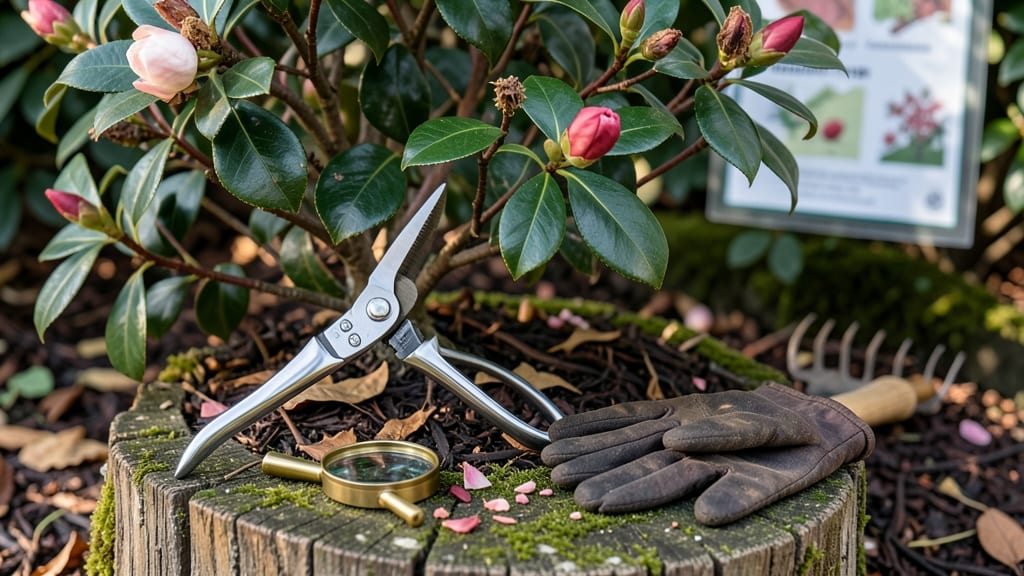
To prune a camellia bush, wait until right after its spring blooms fade—usually between late May and early July—so you don’t accidentally cut off next year’s flower buds that form later in summer. Avoid pruning in fall or winter when new buds are setting.
Camellias develop flower buds in late summer and early fall, which means pruning too early can remove next year’s blooms. 🌸 The key is timing: after the spring flowers drop, you have about 6-8 weeks before fall buds form.
This window lets you shape the bush without sacrificing future blooms. I’ve seen many gardeners accidentally prune too late, only to discover sparse flowers the following spring.
For best results, focus on removing dead or crossing branches during this period. Use clean, sharp pruners to make precise cuts just above a leaf node. This encourages healthy regrowth while maintaining the bush’s natural shape.
If you must prune outside this window, limit yourself to light shaping—never heavy cuts—that won’t affect next year’s blooms.
💡 In This Article
- Camellia Flowering Cycle and Pruning Timing
- Step-by-Step Camellia Pruning Guide by Season
Camellia flowering cycle and pruning timing
Camellias follow a precise annual cycle where flower buds form in late summer and early fall—typically between August and October—to bloom the following spring. This means any pruning done before late May risks cutting off these critical buds before they fully develop.
The buds themselves are tiny, often no larger than a pinhead, and form in the leaf axils along the previous season's growth. When you prune too early, you're essentially removing next year's blooms before they've had a chance to mature.
The ideal pruning window opens only after spring flowers have fully faded and dropped, usually between late May and early July. This gives you about 6-8 weeks before fall bud formation begins. During this period, the plant is actively growing new shoots, making it more resilient to pruning.
The new growth you see after spring blooming is what will produce next year's flower buds—so preserving these shoots is crucial. Think of it like harvesting fruit: you want to wait until the current crop is fully mature before pruning the tree for next season's yield.
What most gardeners don't realize is how quickly these buds develop. By mid-August, the buds are already forming along the new growth, and any heavy pruning after this point risks removing next year's flowers.
The buds are particularly vulnerable because they're located near the stem tips, which are often the first parts to be trimmed during shaping.
For example, a camellia bush that blooms in March will have its buds fully formed by September—so pruning after that date could mean fewer flowers next spring.
There's also a botanical reason why timing matters so much: camellias are evergreen shrubs with a monopodial growth habit, meaning they grow from a single main stem with lateral branches.
Each year's growth produces the flower buds for the following season, and these buds form on the current year's wood. When you prune too late, you're cutting back growth that hasn't yet had a chance to set buds, which is why you might see sparse flowering the next year.
The worst-case scenario is pruning in fall or winter, when the plant is already preparing for next year's blooms.
Consider this comparison: pruning a camellia in June gives the plant 4 months to develop new growth and set buds before winter dormancy, while pruning in September leaves only 2 months for this critical process.
The difference in bloom quantity can be dramatic—sometimes up to 50% fewer flowers if pruned too late. This is why professional gardeners often mark their calendars with the phrase "wait until after the last petal falls" as their pruning cue.
For those who live in regions with extended bloom periods, like the southern United States, the timing might shift slightly later—sometimes into early August. The key is always to wait until all flowers have dropped and the plant has finished blooming for the season.
You can test this by gently shaking a branch: if no petals fall, the blooming cycle isn't complete yet. This simple check helps avoid the common mistake of pruning too soon.