
Pruning
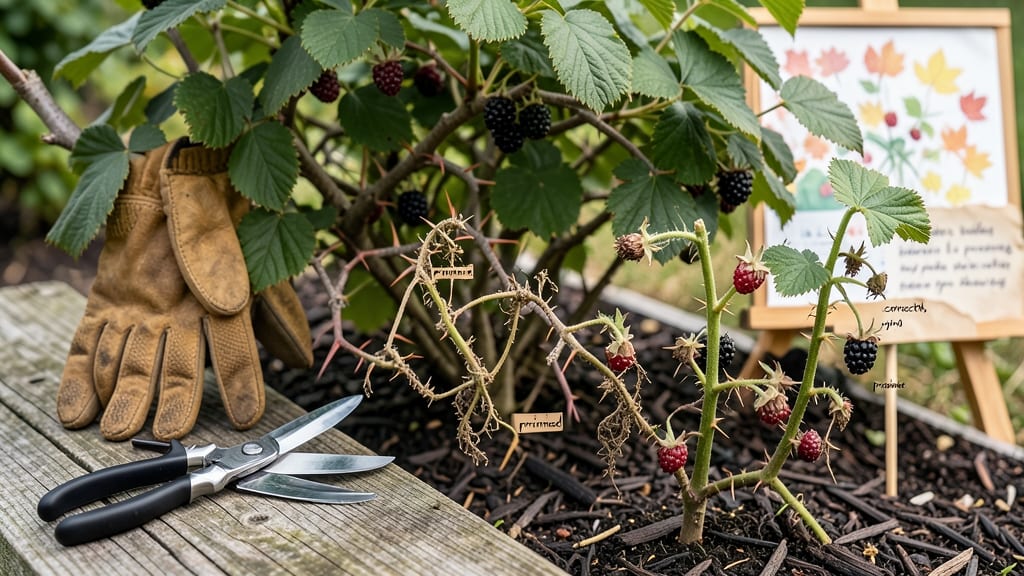
You’re too late to prune blackberries once late winter dormancy ends—usually after early March in most growing zones—but cutting back after you spot new growth (bud swell or leaf emergence) will shrink that season’s fruit harvest and stress the plant. Exact timing shifts with your climate, but delayed pruning often results in weaker canes and a delayed harvest.
Blackberries rely on a precise window between dormancy and active growth to set fruit. 🌱 When you prune too late, you’re essentially cutting off the plant’s energy source just as it’s preparing to flower—this disrupts the entire fruiting cycle.
In warmer climates, like Zones 8-10, dormancy may barely exist, so pruning after February can already be risky. I’ve seen gardeners in these areas accidentally prune away next season’s fruit by waiting until March or April.
The key is to finish pruning before buds swell, as that’s when the plant shifts focus from root development to flowering.
Even if you miss the ideal window, all isn’t lost. If you’ve already pruned too late, focus on removing any dead or diseased canes immediately and avoid further pruning until after harvest.
This minimizes damage while giving the plant a chance to recover. 💫 The goal is to balance fruit production with plant health—late pruning forces the plant to divert energy to regrowth instead of fruiting, which is why you might see smaller berries or fewer canes the following year.
💡 In This Article
- Blackberry Pruning Deadlines by Climate Zone
- How Late Pruning Damages Blackberry Plants
Blackberry pruning deadlines by climate Zone
Blackberry dormancy cycles dictate your pruning deadline, and these cycles vary dramatically by climate zone. In colder regions like Zones 3-6, plants enter dormancy in late fall and remain dormant until late winter—typically through February.
This means your pruning window stretches from late winter (just after the coldest months) until early spring, ideally before bud swell (when buds begin to plump slightly).
In Zone 5, for example, this usually falls between mid-February and early March, while Zone 6 gardeners often have until late March.
Warmer climates like Zones 7-10 complicate things because dormancy is minimal or nonexistent. Here, blackberries may only experience a brief rest period, if at all. In Zone 8, pruning after mid-February risks cutting off next season’s fruit buds, which can emerge as early as late February or March.
I’ve observed that in Florida (Zone 9-10), blackberries often begin active growth by January, so pruning after that point can severely limit fruiting. The key is to prune when the plant is still dormant but buds haven’t yet swollen—this ensures you’re not removing potential fruiting canes.
What triggers dormancy break? Temperature is the primary factor. Blackberries typically resume growth when daytime temperatures consistently reach 50-55°F for several days. In the Northern U.S., this often coincides with late February to early March, while Southern regions may see this shift as early as January.
Pay attention to bud swell—when buds begin to look like tiny green beads, it’s your final warning that pruning time is nearly over. This is when the plant’s energy shifts from root development to preparing for flowering, making late pruning counterproductive.
Here’s how to gauge your local deadline: Monitor the weather and observe your plants. If you see new leaves emerging or canes starting to green up, you’ve missed the ideal window.
In these cases, focus on light pruning—removing only dead or diseased canes—to minimize stress without disrupting the fruiting cycle. 🌿 The goal is to preserve as much of the plant’s energy as possible for fruit production, even if you’re late to the game.
For gardeners in transitional zones (like Zone 7), the deadline can be especially tricky. A warm spell in February might trick plants into early growth, while a late cold snap could delay it.
In these cases, err on the side of caution: finish pruning by mid-February unless you’re certain the plant remains dormant. The risk of cutting off next year’s fruit is simply too high to wait.
Consider this real-world example: A friend in Georgia (Zone 8) pruned her blackberries in early March, only to discover she’d accidentally removed half of her fruiting canes.
The lesson? When in doubt, prune earlier rather than later. The plant’s resilience is impressive, but it can’t recover what’s already been cut away.