
Pruning
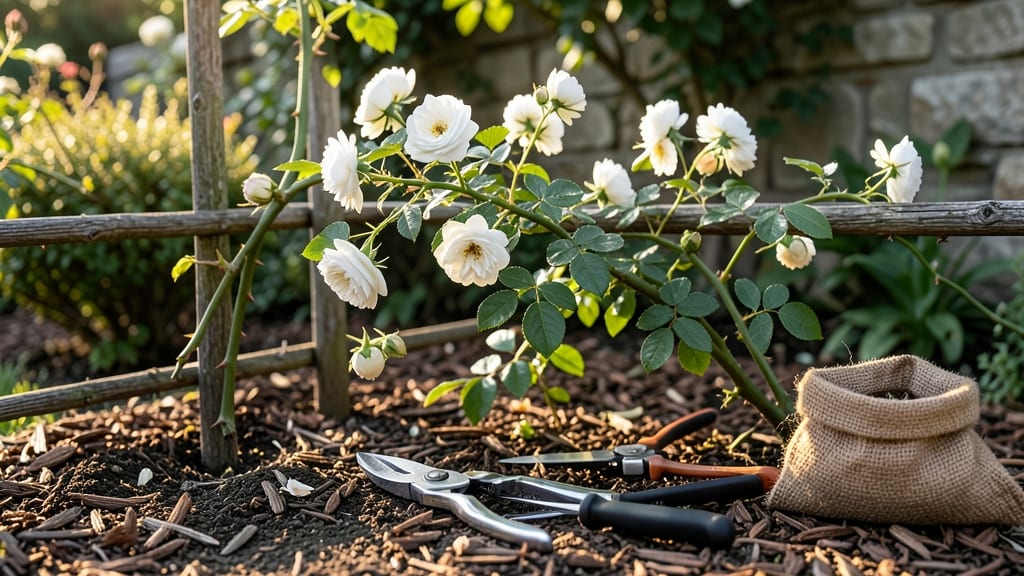
Pruning a Lady Banks rose in late winter isn’t just about shaping—it’s about setting up a dramatic spring show that makes your garden the envy of the neighborhood. 🌸 I’ve learned the hard way that skipping this step means leggy canes and fewer blooms, but when done right, your rose will reward you with cascading clusters of fragrant flowers by May.
The key is timing: wait until the last hard frost has passed, but before new growth starts—usually February or early March in most climates.
You’ll need sharp secateurs (dull blades crush stems), pruning shears for thicker canes, gloves (Lady Banks roses have thorns), and a disinfectant to clean tools between cuts.
The goal is to open the center of the plant by removing old, crossing, or weak canes—never cut more than one-third of the plant at once. Lady Banks roses bloom on new wood, so prune just above an outward-facing bud to encourage strong growth.
And here’s the secret: leave the long, flexible canes—they’re the rose’s superpower for climbing and producing those iconic, foot-long blooms.
After pruning, give your rose a light feeding with a balanced fertilizer (10-10-10) and a deep watering to help it recover. Watch as new shoots emerge within 2-3 weeks, and by late spring, your walls or trellis will be draped in velvety pink or red blooms.
The fragrance alone is worth the effort—imagine stepping into your garden and being hit with that sweet, intoxicating scent that lingers all day. Just avoid the common mistakes: don’t over-prune (you’ll sacrifice next year’s blooms), and never use hedge trimmers—they tear the canes and invite disease.
This method works for both climates and spaces—whether you’re training your rose up a fence in Zone 7 or coaxing it along a balcony trellis in Zone 9.
The only real rule is to prune annually, and you’ll have a rose that’s healthier, more productive, and showier than anything from a nursery. Ready to transform those bare winter canes into a springtime masterpiece?
📚 In This Guide
- What you need
- Instructions
- Tips and common mistakes
- Wrapping up and next steps
What you need
- ● Bypass pruners: Sharp, high-quality pruners (e.g., Felco or Corona) to make clean cuts—avoid dull blades!
- ● Loppers: For thicker stems (1–2 inches in diameter); look for 4–6 inch cutting capacity.
- ● Hand saw: A pruning saw with a fine-tooth blade for stubborn, woody stems.
- ● Disinfectant: 70% isopropyl alcohol or a bleach-water solution (1 part bleach to 9 parts water) to sterilize tools between cuts.
- ● Garden gloves: Heavy-duty, cut-resistant gloves (e.g., Mechanix or Filon) to protect your hands.
- ● Bucket or trash bag: For collecting pruned branches—1–2 gallon capacity should suffice.
- ● Pruning sealant: Tree wound paint (e.g., Dykem) to coat cuts larger than ½ inch—controversial but some swear by it!
- ● Ladder or stool: If your rose bush is taller than 6 feet.
- ● Notebook & pen: To sketch your pruning plan or jot down notes on stem health.
- ● Compost bin: For repurposing healthy pruned branches.
- ● Check the last frost date in your zone—prune 2–4 weeks before to avoid damaging new growth.
- ● Ensure your rose is dormant (no leaves or buds) for the cleanest cuts.
- ● Gather sunny, dry weather—pruning in wet conditions can spread disease.
How to prune a Lady Banks rose for maximum spring growth
This is the moment that transforms a tangle into a showstopper—late winter's the perfect time to shape your Lady Banks rose.
✂️ Step 1: Gather Tools and Assess the Rose
Start with sharp, clean pruners and a pair of gloves—Lady Banks roses have thorns that can draw blood if you're not careful. I always disinfect my tools with rubbing alcohol first to prevent spreading disease between cuts. Grab a notepad to sketch your plan if needed; visualizing the structure helps avoid over-pruning.
Examine the rose's framework while it's still dormant. Look for the main stems (called canes) that form the plant's skeleton. These should be at least ½ inch thick at the base. Thin, spindly canes that don't have buds are prime candidates for removal. The goal is to create an open center that allows light and air to circulate freely.
✂️ Step 2: Remove Dead, Diseased, or Weak Growth
First, cut out any dead or diseased wood—you'll recognize it by its hollow centers or dark, mushy texture when you slice into it. Make your cuts at a 45-degree angle, about ¼ inch above a healthy bud that faces outward from the center. This angled cut helps rainwater run off instead of pooling at the wound.
Next, identify and remove any crossing branches or canes that rub against each other. These create wounds that invite disease. If two canes are growing parallel to each other, keep the stronger one and cut the weaker at its base. I always step back after each cut to visualize the new shape—it's easy to get tunnel vision and miss the bigger picture.
✂️ Step 3: Thin Out Overcrowded Canes
Lady Banks roses bloom on old wood, so we're not cutting back to encourage new growth—we're sculpting the framework. Aim to space remaining canes about 6-8 inches apart at the base. This spacing prevents future overcrowding and ensures each cane gets adequate sunlight and air circulation.
Remove any canes that are growing inward toward the center of the plant. These won't receive enough light to bloom well and will create a dense, shaded interior. Cut these back to their point of origin at the main stem. Remember, you can't over-prune a Lady Banks—it's more forgiving than many roses, but the key is to maintain that open, airy structure.
☀️ Step 4: Shape for Optimal Light Exposure
Now's the time to create your plant's final form. Step back and imagine sunlight streaming in from all directions. Your goal is to create a vase-like shape with the strongest canes positioned outward. Cut back any remaining canes that are growing too upright—they'll cast shade on lower buds and reduce flowering.
Make your final cuts just above an outward-facing bud. This encourages new growth to develop away from the center, creating a fuller, more balanced plant. I like to leave about 12-18 inches of height on the strongest canes after pruning. This gives the plant enough structure to support the heavy spring blooms while still allowing room for new growth.
🌱 Step 5: Clean Up and Prepare for New Growth
After all cuts are made, gather all the pruned material and dispose of it properly. Don't compost diseased wood—burn it or put it in the trash to prevent spreading pathogens. Sweep up any fallen leaves or debris from around the base of the plant. This reduces hiding places for pests and diseases that could affect new growth.
Apply a 2-3 inch layer of mulch around the base (but not touching the stems) to protect roots from temperature fluctuations and retain moisture. Water deeply at the base to help the plant recover from the pruning shock. Within 3-4 weeks, you'll see new growth emerging from the buds you left—this is your reward for careful pruning.
Tips & tricks for perfect Lady Banks rose pruning
Late winter pruning transforms your Lady Banks rose from tangled mess to spring blooming star—here's how to avoid common mistakes and elevate your results.
Tool Preparation: Beyond sharp pruners and gloves, I recommend keeping a small spray bottle of rubbing alcohol handy for quick disinfection between cuts. This prevents cross-contamination when removing diseased wood in Step 2. Also, use a pair of loppers for any canes thicker than your wrist—your pruners will thank you. The 45-degree angle mentioned in Step 2 is crucial, but if you're struggling, practice on a scrap piece of wood first to get comfortable with the technique.
Visualization Technique: In Step 1, when assessing your rose's framework, I've found that holding a small mirror near the plant helps identify hidden canes growing toward the center. This is especially helpful for Lady Banks roses that develop dense growth patterns. After each major cut in Steps 2-4, step back and trace the plant's silhouette with your finger—this mental mapping helps ensure you're maintaining that open vase shape we're aiming for.
Bud Identification: The outward-facing bud rule in Step 4 is key, but here's what to watch for: healthy buds should be plump and firm, not shriveled or cracked. In late winter, some buds may still be dormant—press gently to feel for the slight swelling that indicates viability. If you're unsure whether a bud is healthy, err on the side of caution and cut above it anyway; Lady Banks roses are remarkably forgiving when it comes to pruning.
Post-Pruning Care: The 2-3 inch mulch layer in Step 5 deserves special attention—use organic mulch like wood chips or shredded leaves, which will break down and enrich the soil. Avoid inorganic mulches that can suffocate roots. After pruning, I make it a habit to mark the plant's location with a small stake and note the date—this helps me track growth patterns year after year and plan future pruning sessions more effectively.
Pro Tips for Pruning Lady Banks Rose
- Late winter pruning transforms your Lady Banks rose from tangled mess to spring blooming star—here's how to avoid common mistakes and elevate your results.
- Tool Preparation: Beyond sharp pruners and gloves, I recommend keeping a small spray bottle of rubbing alcohol handy for quick disinfection between cuts.
- Visualization Technique: In Step 1, when assessing your rose's framework, I've found that holding a small mirror near the plant helps identify hidden canes growing toward the center.
Frequently asked questions
Got questions about pruning your Lady Banks rose? You’re not alone! Here are answers to the most common concerns—so you can tackle late-winter cuts with confidence and watch those dramatic spring blooms shine.
When is the exact best time to prune a Lady Banks rose?
The ideal window is late winter to early spring (just before new growth starts), typically February to March in most U.S. zones. Avoid pruning after buds swell—this can stress the plant. Pro tip: If you missed the window, wait until after the first flush of blooms in spring!
How much can I cut back my Lady Banks rose?
These climbers thrive on bold cuts! Aim to reduce last year’s growth by 1/3 to 1/2, focusing on dead, weak, or crossing branches. Never cut into old wood—Lady Banks roses bloom on new growth, so leave at least 3–5 healthy buds per stem. Warning: Over-pruning can delay blooming!
What if my rose doesn’t bloom after pruning?
No blooms? Check these fixes:
- Light: Ensure it gets 6+ hours of sun daily—Lady Banks roses are sun-worshippers!
- Fertilizer: Feed with rose-specific fertilizer (high in phosphorus) in early spring.
- Age: Young plants (under 2 years) may need 1–2 more seasons to establish.
Can I prune a Lady Banks rose in fall?
Light fall cleanup (removing dead/diseased wood) is fine, but avoid heavy pruning—it stimulates tender new growth that won’t survive winter. Save major cuts for late winter. Exception: In mild climates (Zones 8–10), minimal pruning can happen year-round.
What’s the difference between pruning Lady Banks and other roses?
Lady Banks roses are climbing, repeat-blooming types, so they need less aggressive pruning than hybrid teas or floribundas. Focus on:
- Shape: Train vines along trellises or fences for airflow.
- Bloom stimulation: Cut just above outward-facing buds to encourage lush growth.
- Avoid: Topping (cutting straight across) or removing too many stems—this reduces next year’s flowers!
Wrapping up and next steps
Pruning your Lady Banks rose in late winter isn’t just about tidying up—it’s your secret weapon for showstopping spring blooms! 🌸 With the right tools, timing, and technique, you’ll encourage healthier growth and a cascade of fragrant flowers.
Remember, confidence comes with practice, so don’t hesitate to roll up your sleeves and get hands-on.
Ready to transform your rose into a blooming masterpiece? Grab your pruners, review your notes, and schedule your pruning session on a clear, calm day. Your garden—and future visitors—will thank you! 🌿✨