
Pruning
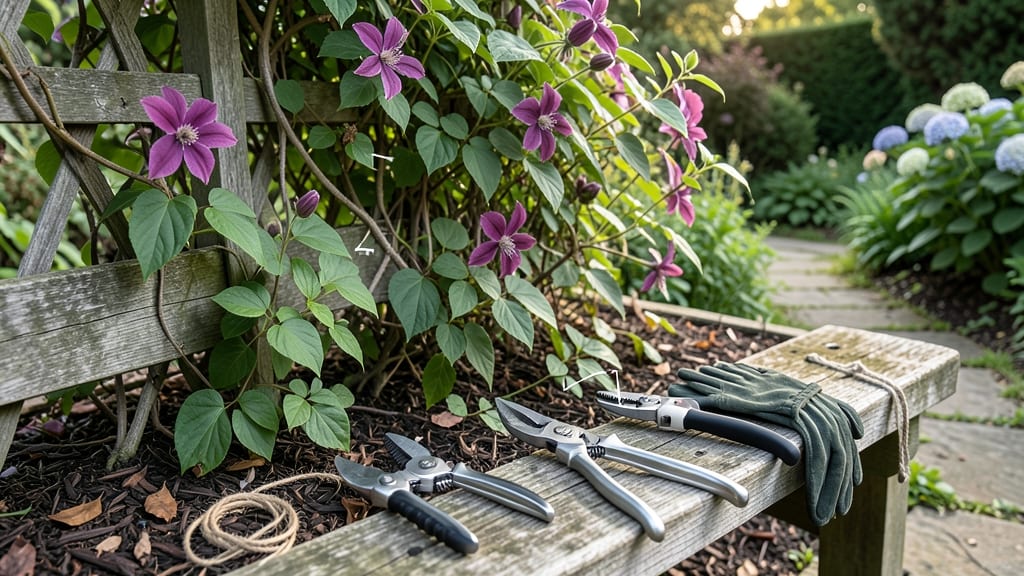
Clematis should be pruned according to its blooming type—group 3 varieties (late bloomers) need early spring cuts, group 2 (repeat bloomers) thrive with late winter pruning, while group 1 (early bloomers) must never be trimmed until after their flowers fade. Getting this wrong can weaken the plant or even kill it, so matching your pruning to the right growth cycle is essential.
Pruning clematis isn't just about cutting back—it's about working with the plant's natural rhythm. 🌿 Group 1 varieties, which bloom on old wood, rely on last year's growth, so pruning too early removes their flower buds. Meanwhile, group 3 plants need aggressive early spring cuts to encourage robust summer blooms.
I always check stem thickness and flower timing first to confirm which category my clematis belongs to, as this determines whether I should prune lightly or heavily.
Timing matters just as much as technique. Late winter pruning for group 2 plants (like 'Jackmanii') gives them time to establish new growth before summer heat arrives. The key is to cut just above a healthy bud or pair of buds, never leaving stubs or cutting into old wood.
This ensures the plant has energy reserves for its next blooming cycle.
💡 In This Article
- Clematis Pruning Groups: Identifying Your Plant’s Needs
- Step-by-Step Clematis Pruning Guide for Beginners
Clematis pruning groups: identifying your plant’s needs
Clematis plants are divided into three pruning groups based on when and where they bloom, each requiring a distinct approach. Group 1 varieties bloom on last year's growth (old wood) in early spring, like 'Early Sensation' or 'Nelly Moser,' which means cutting too early removes their flower buds entirely.
Group 2 plants bloom twice—first on old wood in early summer, then again on new growth later in the season, such as 'Jackmanii.' Group 3 varieties bloom exclusively on new wood in late summer or fall, like 'Perle d'Azur,' and need aggressive pruning in early spring to stimulate vigorous regrowth.
The key to identifying your clematis lies in observing its stems and flower timing. Group 1 stems are typically thicker (about 1/4 inch in diameter) and produce blooms within 2-3 weeks of spring's arrival.
Group 2 stems are medium-thick and show two distinct bloom cycles: the first flush appears on last year's growth, followed by a second wave on new shoots.
Group 3 stems are usually thinner (around 1/8 inch) and only bloom on current season's growth, which emerges after severe pruning. 🌸 Pay attention to these visual cues—misidentifying your plant's group can lead to missed blooms or stunted growth.
Understanding these groups explains why timing matters so critically. Group 1 plants store energy in their old wood during winter, so pruning before their buds swell risks removing their entire blooming potential.
Group 2 plants need a light cut after their first bloom to encourage the second flush, while group 3 varieties require a hard cut back to 12-24 inches above ground level in early spring.
The science behind this is simple: clematis flowers form in buds that develop on the previous year's growth for groups 1 and 2, while group 3 relies entirely on current season's new shoots.
Here's how to test your plant's group if you're unsure: Observe its blooming pattern over two seasons. If it flowers only once in early spring, it's group 1. If it blooms twice—once early and again in late summer—it's group 2.
If blooms appear only in late summer or fall, it's group 3. This hands-on approach eliminates guesswork and ensures you're pruning at the optimal time for your specific variety.
What most gardeners don't realize is that clematis stems have a distinct texture that changes with age. New growth is typically smoother and more vibrant green, while old wood develops a rougher bark.
When pruning group 3 plants, always cut back to these younger stems—you'll notice the contrast immediately as you work. This visual distinction helps prevent accidental over-pruning of valuable old wood that might still contain dormant buds.
Consider these key factors when identifying your clematis group:
- Group 1: Thick stems, single early spring bloom, flowers on old wood
- Group 2: Medium stems, two bloom cycles (spring and summer), flowers on both old and new wood
- Group 3: Thin stems, late summer/fall blooms, flowers only on new wood
Once you've identified your plant's group, you'll have a clear roadmap for when and how much to prune—no more second-guessing or risking damage to your beautiful clematis. 💫